As mentioned in an earlier post, Luke 2 is probably the most famous Christmas story, even though it doesn't have the story about the wise men or the star. In my mind it will always stand out because of the Charlie Brown Christmas Special. God's blessings to all of you on your Christmas and New Year celebrations!
Sunday, December 18, 2011

Wednesday, December 14, 2011
Motivated
Matthew Chapter Six has some examples of actions. The actions, themselves, are not bad, but Jesus is concerned about the motivation behind the actions: giving to poor people, praying, fasting. All of those are good spiritual practices. God is not just concerned with the actions, though; God cares about the heart of a person.
The reason is that when you get past the action of giving to the poor, there might be some selfishness behind it.
Giving money to the Salvation Army at Christmas is a nice thing to do. They help a lot of people, and they share the hope of Jesus when they also share necessities. The question is, "Why are you giving to the Salvation Army?" There are some good reasons:

The reason is that when you get past the action of giving to the poor, there might be some selfishness behind it.
Giving money to the Salvation Army at Christmas is a nice thing to do. They help a lot of people, and they share the hope of Jesus when they also share necessities. The question is, "Why are you giving to the Salvation Army?" There are some good reasons:
- Help the poor people
- Show your family you are generous
- Be a witness to others
- Get a tax write off
Those might be good reasons, but they are not what God would be hoping for. The action is good, the reason might be good, but the heart is rather selfish. In reverse order:
- "I" want to pay less taxes
- "I" want to impress other people
- "I" want to impress my family
- "I" want to impress myself
There are probably different levels of being selfish. The first level would consist of not giving money and wanting to keep it. Another level would be giving the money for selfish reasons. It's unfortunate, but often people are encouraged to give to charities for selfish reasons, even if they are well disguised.
God has blessed all of us with more things than we deserve. It's easy to get caught up in comparing ourselves to someone who has more, but God has given all this out of his love for us. When that love sinks deep into us so that it covers every nook and cranny in our souls, there is nothing that would be able to stop us from responding in love. That's giving with a cheerful heart.
This doesn't just apply to the the action listed in Matthew chapter six, but it could apply to any action. That is something to think about. I would challenge you to think of even the most obscure things that you do. Then think about your motivation.
I don't think that Jesus is trying to make people feel guilty or bad or anything like that in these chapters. He's encouraging us. He's saying, "Bask in my love! If you're not feeling my love, then maybe you don't understand just how deep my love for you is. Let it fill you."
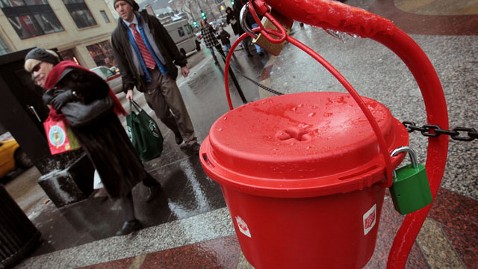
Image from ABC New
Friday, December 9, 2011
Kneading Thoughts on Needing Bread
What do you really need? There are probably more things that we think we need than we actually need. According to our science class, we need food, air, water, and shelter. Society would say you need a job, community, and transportation. The stores before Christmas tell me that I need the latest gadgets and electronics, and I am often tempted to think they are right.
Some theorists would say that we need safety, a purpose, and our highest need is love. That may true God is love. 1 John 4:8.
Six out of the seven petitions in the Lord's prayer deal with concerns that might be considered more spiritual: holiness, God's will, God's kingdom, forgiveness, temptation, evil. One of the encapsulates all the physical concerns we have.
This is a little different than the version we usually say in church or chapel. One of the more significant differences is the request to keep us away from "the evil one" and not just "evil" in general. That makes me curious why it would be rendered differently. That middle verse, 11, is about physical things and it calls those things 'daily bread.' It would have reminded people during Jesus' day about the Israelites who were only supposed to collect enough food for one day and depend on God. It would also have reminded them of a Proverb.
Proverbs 30:8-9
8 Keep falsehood and lies far from me;
give me neither poverty nor riches,
but give me only my daily bread.
9 Otherwise, I may have too much and disown you
and say, ‘Who is the LORD?’
Or I may become poor and steal,
and so dishonor the name of my God.
It also might remind us that in John 6, Jesus referred to himself as the Bread of Life, the food that people really need.
As far as 'things': not too much, not too little. As far as 'God': the more the better.

Some theorists would say that we need safety, a purpose, and our highest need is love. That may true God is love. 1 John 4:8.
Six out of the seven petitions in the Lord's prayer deal with concerns that might be considered more spiritual: holiness, God's will, God's kingdom, forgiveness, temptation, evil. One of the encapsulates all the physical concerns we have.
Matthew 6:9-13
9 “This, then, is how you should pray:
“‘Our Father in heaven,
hallowed be your name,
10 your kingdom come,
your will be done,
on earth as it is in heaven.
11 Give us today our daily bread.
12 And forgive us our debts,
as we also have forgiven our debtors.
13 And lead us not into temptation,
but deliver us from the evil one.’
hallowed be your name,
10 your kingdom come,
your will be done,
on earth as it is in heaven.
11 Give us today our daily bread.
12 And forgive us our debts,
as we also have forgiven our debtors.
13 And lead us not into temptation,
but deliver us from the evil one.’
This is a little different than the version we usually say in church or chapel. One of the more significant differences is the request to keep us away from "the evil one" and not just "evil" in general. That makes me curious why it would be rendered differently. That middle verse, 11, is about physical things and it calls those things 'daily bread.' It would have reminded people during Jesus' day about the Israelites who were only supposed to collect enough food for one day and depend on God. It would also have reminded them of a Proverb.
Proverbs 30:8-9
8 Keep falsehood and lies far from me;
give me neither poverty nor riches,
but give me only my daily bread.
9 Otherwise, I may have too much and disown you
and say, ‘Who is the LORD?’
Or I may become poor and steal,
and so dishonor the name of my God.
It also might remind us that in John 6, Jesus referred to himself as the Bread of Life, the food that people really need.
As far as 'things': not too much, not too little. As far as 'God': the more the better.
"God, help us want You!"

Sunday, December 4, 2011
Light

Light is pretty is a pretty important part of the Christmas season. Candle-light services are popular. Advent wreaths progress with light until Christmas. Christmas lights decorate many houses and businesses. It's Biblical. John wrote that about Jesus coming into the world at Christmas time and said, "The true light that gives light to everyone was coming into the world." Isaiah said "The people walking in darkness have seen a great light." A little while later in Isaiah chapter 9 we have the Christmas verses, "For unto us a child is born."
Jesus is the light. By him being present in our lives, we shine forth, as well. This is why Jesus says,
Matthew 5:16
In the same way, let your light shine before others, that they may see your good deeds and glorify your Father in heaven.
Jesus did not say that you might have the opportunity to be the light if you work really hard at it. You are the light of the world, so let those lights shine for the right reasons. Love shines bright. Let it shine.
How do you shine? By living differently than our dark world. By looking to follow the heart of God and not just the letter of the law. Jesus went on to say,
Matthew 5:43-44
43 “You Matthew 5:43-44have heard that it was said, ‘Love your neighbor and hate your enemy.’ 44 But I tell you, love your enemies and pray for those who persecute you
Love shines bright. Let it shine.
Tuesday, November 29, 2011
Some Numbers
There are some significant numbers in the Bible, so it might be a good idea to list a few of them. They tend to appear from time to time, like the number 14 for David. Most of them are more common than that one, though, so we'll run through a quick list of important numbers.

Three is a number that is usually associated with God or heaven or spiritual things. Some important three's would include the 3 person of God in the Trinity and Jesus being in the tomb for three days.

Four, on the other had, is a very earthly number. There are four directions (north, east, south, west), four seasons (spring, summer, fall, winter), four hemispheres, and four ancient elements (earth, wind, fire, water). This brings significance to Jesus' heavenly resurrection (three days in the tomb) compared to Lazarus' earthly resurrection (four days in the tomb).

When you add three and four, you get the complete number 7. Seven shows up a lot in the book of Revelation symbolizing completeness. A week is complete with seven days, like the seven days of creation. When Revelation was sent to the seven churches, it could be argued that it was sent to all the churches, the 'complete' number of churches.

One less than complete would be the devil's number of 6. The devil tries to imitate God's completeness, but comes up short.

10 is a number that represents power. Numbers are often multiplied by powers of ten. The beast in Revelation having 10 horns is a symbol of power.

The church is represented by the number 12. The people of God in the Old Testament were the twelve tribes of Israel. The people of God in the New Testament followed the teachings of the twelve disciples. All the people of God surround God's throne, represented by the twenty-four elders (12 + 12).

And 40 is a number for change. The earth was changed in the forty days it rained during Noah's time. The Israelites were changed during forty years of wandering in the desert. Moses was changed after spending forty days on the mountain with God. Jesus was changed during his temptations in the desert, being prepared for ministry. As a side note, it is also interesting the change that happened from 1968 when Martin Luther King Jr. was assassinated to 2008 when our first African-American president was elected - 40 years.
Friday, November 25, 2011
Not Only Jesus' Temptations
Jesus faces temptations from the devil in Matthew chapter 4. While we may not have the same literal temptations, we often have similar temptations as redeemed children of God.

.jpg)
Mosaic from San Marco Basilica in Venice, Italy
We may not have the temptation to turn rocks into hamburgers, but we do have the temptation to use the power and influence we have as followers of Christ for our own good. Unfortunate extreme examples of this would include the list of televangelists who have run into trouble with the law for using their power and influence for themselves.
We may not have the temptation to jump off the roof of tall buildings, but we do have the temptation to twist the words of the Bible to fit our needs instead of trying to understand what God is trying to tell us. For instance, I know that many students like the verse "I can do all things through Christ who strengthens me" from Philippians 4, but Paul was not referring to a science test or basketball game. Knowing what the context of a passage is will tell us a lot about what God wants to say to us in his Word.
We may not face the temptation of controlling the whole earth, but we do face the temptation of losing track of God's intentions and following our own earthly desires instead. Later in Matthew, Jesus questions his followers if it is really helpful to gain the whole world while losing your soul.
Jesus' response to the devil was to quote God's Word. It may be that Jesus learned verses so that he had an answer for the devil, but it would probably be more accurate to say that Jesus spent so much time in God's Word that it influenced the way that he thought. The temptations of the devil immediately triggered a response from Jesus since it conflicted with something in Scripture that he already knew was true. Even the short quotations would have referenced a larger passage, such as Deuteronomy 6:13-16.
13 Fear the LORD your God, serve him only and take your oaths in his name. 14 Do not follow other gods, the gods of the peoples around you; 15 for the LORD your God, who is among you, is a jealous God and his anger will burn against you, and he will destroy you from the face of the land. 16 Do not put the LORD your God to the test as you did at Massah.
As we pass the Thanksgiving holiday and turn toward Advent and the Christmas season, I thought it would be important to look at another key passage that predicts Jesus' birth and work.
Isaiah 9:6-7
6 For to us a child is born,
to us a son is given,
and the government will be on his shoulders.
And he will be called
Wonderful Counselor, Mighty God,
Everlasting Father, Prince of Peace.
7 Of the greatness of his government and peace
there will be no end.
He will reign on David’s throne
and over his kingdom,
establishing and upholding it
with justice and righteousness
from that time on and forever.
The zeal of the LORD Almighty
will accomplish this.
to us a son is given,
and the government will be on his shoulders.
And he will be called
Wonderful Counselor, Mighty God,
Everlasting Father, Prince of Peace.
7 Of the greatness of his government and peace
there will be no end.
He will reign on David’s throne
and over his kingdom,
establishing and upholding it
with justice and righteousness
from that time on and forever.
The zeal of the LORD Almighty
will accomplish this.
Monday, November 21, 2011
Biblical Thanksgiving
Where do you see "Thanksgiving" in the Bible? What stories stand out? Here are two collections of words from Bible verses and Bible stories that students found in religion class this week. The more times the words were found in our verses and stories, the bigger the words. The top collection is from Mrs. Durst's homeroom and the bottom is from Mr. Luehmann's. God's blessings to all of you on your thanksgiving.
Subscribe to:
Posts (Atom)