Friday, April 26, 2013

Pouring Out the Spirit


How will the world end?  Jesus said it could happen at any moment, so we should be ready.  But ready for what?  There is a lot of descriptive language about what will happen in the last days, but it is not completely clear how it will all unfold.  Comparing Jesus' life to the Old Testament prophecies about the Messiah makes his fulfillment clear to us as we look back, but if it would have been clear to everyone at the moment, then I think the religious leaders would have treated him differently.  In light of that, I would have a hard time claiming to know exactly how the world will end.

Much of the controversy about the end of the world can be traced to a few verses at the beginning of Revelation chapter 20 which talk about a thousand year period of time.  There are three basic views of what these verses are referring to.  Pre-millennialists would envision this thousand years of Christ reigning on earth happening before "Judgment Day" and the end of time.  Post-millennialists would see "Judgment Day" coming first, followed by the the thousand year reign of Christ on a perfect and restored earth; this would be the view of many who believe in a literal rapture and period of tribulation as described in the popular book and series Left Behind.  The rest tend to fall into the amillennialist category which view the thousand year reign of Christ (along with many other events in John's Revelation) as symbolic; this would be the category that most Lutherans and Catholics fall into.

Revelation is a confusing book.  There are many strange and unexpected characters and events in this book, but overall message is this: times are bad and they are going to get worse, but hang in there because we win!  (We, meaning Jesus and all who belong to him).  This is why the command is given to be faithful to the point of death and Jesus will give us a crown of life.

But there was a different prediction that Jesus made which I think is more significant; it was a prediction about that which was going to help them get through the hard times coming up.  It was about the Spirit.  The night before Jesus died, he was preparing the disciples for his absence, but promising the gift of the Holy Spirit - the Spirit would help them remember the things that Jesus taught, understand the things that Jesus taught, and know how to continue to be a "little Christ" after he was gone. John 14:15-27

 In the Old Testament, a person had to be really important to have the Holy Spirit.  The prophets would speak about "being in the Spirit" or having "the Spirit of the Lord upon me."  The kings would be anointed (oil poured on their heads) as a symbol of God's Spirit being placed upon them.  The common people had to go through someone important to have access to God's Spirit.  Imagine the amazement people had when they heard the words of the prophet, Joel:

Joel 2:28-32
28 “And afterward, 
   I will pour out my Spirit on all people. 
Your sons and daughters will prophesy, 
   your old men will dream dreams, 
   your young men will see visions. 
29 Even on my servants, both men and women, 
   I will pour out my Spirit in those days. 
30 I will show wonders in the heavens 
   and on the earth, 
   blood and fire and billows of smoke. 
31 The sun will be turned to darkness 
   and the moon to blood 
   before the coming of the great and dreadful day of the LORD. 
32 And everyone who calls 
   on the name of the LORD will be saved;

All people would have the Spirit poured on them!  This was made possible by the cross.  When Jesus died, the temple curtain was torn in two and access to God was made available to all people - not just the prophets or kings or religious leaders.  And the Holy Spirit came with power.

From St. Nicolai Kirche in Lubbenau, Germany

Fifty days after Easter, the Holy Spirit came into Jerusalem with the sound of a howling wind, appearing as small flames upon the heads of the disciples who were speaking clearly and fluently and languages they did not know.  Peter preached to the crowd and explained what was happening by referring them to the prophecy in Joel:

Acts 2:17-21
17 “‘In the last days, God says, 
   I will pour out my Spirit on all people. 
Your sons and daughters will prophesy, 
   your young men will see visions, 
   your old men will dream dreams. 
18 Even on my servants, both men and women, 
   I will pour out my Spirit in those days, 
   and they will prophesy. 
19 I will show wonders in the heavens above 
   and signs on the earth below, 
   blood and fire and billows of smoke. 
20 The sun will be turned to darkness 
   and the moon to blood 
   before the coming of the great and glorious day of the Lord. 
21 And everyone who calls 
   on the name of the Lord will be saved.’

How does that help us approach the end of the world?  The Spirit helps us know what to say and how to live and how to be Christians, even in places that are hostile toward God's ways.  You, too, have the gift of the Holy Spirit.  You, too, have been given the power that was promised to the followers of Jesus!

Friday, April 19, 2013

Greatest Command


There was a "expert" in the law that tried to fool Jesus.  He was trying to give him a no-win question, a question with no right answer (or maybe just a lot of wrong answers).  The question was about the Law.

The Jewish leaders were dependent on the Law - also referred to as the Torah, the Pentateuch, the Books of Moses, the first five books of our Bible.  There are 613 laws found in these books.  Symbolically, Jewish prayer shawls will often be made with 613 knots or tassels to represent the commands of God.  We hold the Ten Commandments to be some of the most important, but this leader figured that he could argue with Jesus about the best commandment, depending on which one he chose.  So how would Jesus respond to a question about which commandment was the greatest?


Love God.  Love other people.  That sums it up - all of the Law (Genesis through Deuteronomy) and the Prophets (most of the rest of the Old Testament).  It is not an emotion that we feel for someone on Valentines day; love is a verb that describes an action.

First, that action should be directed toward God.  We love God first and foremost.  When we love someone, we also love the things which that person loves and care about the things which that person cares about.  Loving God brings us to our second command.

Love others.  God loves all of his people and he calls us to love them as well.

If the first commandment about loving God is the vertical line and the second commandment about loving others is the horizontal line, then the Cross is where these two lines come together - the perfect example of love.  God calls us to love.

Even the commandments seem to follow this pattern:
1 You will have no other gods
2 You will not take God's name in vain
3 Remember the Sabbath day
(all three are about loving God)

4 Honor your father and mother
5 You will not murder
6 You will not commit adultery
7 You will not steal
8 You will not bear false witness
9 You will not covet your neighbor's house
10 You will not covet anything else of your neighbor
(all seven of these are about loving others and how we live while loving others)

The greatest commandment is to love.

Sunday, April 14, 2013

Inside vs. Outside


What do you see when you look at ice cream?  Do you see heaven?  Temptation?  Memories?  Calories?  When my son was three years old, he was most impressed with ice cream when it had brightly colored sprinkles.  For him, that is what made good ice cream.  Even though I feel that they do not add much to the taste of ice cream, it was more fun for him to eat the ice cream if it has sprinkles.


What do you see when you look at people?  It's not what God sees.  The first king of Israel, Saul, had made so many mistakes as the leader of God's people that God was done with him.  Samuel, the prophet, was told that he would find the next king at Jesse's house.  The oldest son walked out of the house and Samuel was getting his anointing gear out - this guy was tall, handsome, strong, and bound to be a much better leader for the people of God.  But God didn't agree.  He was looking for something else, someone else.  

1 Samuel 16:7
But the LORD said to Samuel, “Do not consider his appearance or his height, for I have rejected him. The LORD does not look at the things people look at. People look at the outward appearance, but the LORD looks at the heart.”

David is known as being a man after God's own heart.  No other mortal has ever been given such a title.  Was it because he as perfect as possible?  Probably not.  David was responsible for murderadulterypoor parenting, and the death of thousands of Israelites.  Still, David was known as being a man after God's own heart.  David is known for doing great things like defeating the Philistines, beating Goliath with a slingshot, and writing incredible psalms of praise to God.  I don't think it was any of those things that made him great.  If I had to pick one thing that makes David stand out for me, it was his humility.  He was honest when he sinned, and confessed it straight to God in Psalm 51.  Humility is a powerful characteristic of a leader.

The outside of people do not always reflect what God sees, but events are also not always what they seem.  One of the biggest questions I had as a child was why the cool stuff of the Bible doesn't happen anymore.  I would love to have seen the plagues on Egypt, crossing the Red Sea, a kid beating a 9 foot tall giant, Noah's boat, the men walk out of the fiery furnace, a guy walking on water, or feeding thousands of people out of one lunch box.  Why don't miracles happen any more?

Hebrews 1:1-2
1 In the past God spoke to our ancestors through the prophets at many times and in various ways, 2 but in these last days he has spoken to us by his Son, whom he appointed heir of all things, and through whom also he made the universe. 

I read these verses at least a dozen times before I realized what they meant, and it's related to another powerful question: what does God look like?  We would say Jesus, and we would be right.  What about before Jesus?  What did God look like to Isaiah or Nehemiah?  How would you describe God?  There were no idols, so you couldn't point to the image of a calf or beast or even a person.  God was known by what he did.  He was the God who called Abraham, the God who gave Moses the commandments, the God who was a pillar of fire by night and cloud by day, the God who rescued Daniel from the lions... In the past, that is how God spoke to people - using the events and prophets.  But if you really want to know what God looks like, look to Jesus.  Jesus is the ultimate way God speaks to His People.

So do miracles still happen?  I would say yes!  There have been miracles involving missionaries and angels all over the world.  I don't know if hockey in 1980 counts, but even so, there have been wonderful glimpses of God working in a unique way in people's lives.  The key is that even though miracles may happen, the ultimate way God stills speaks to people is through the person of Jesus.

Friday, April 5, 2013

Dealing with Conflict


Where two or three are gathered, there is conflict.  Communities of people are wonderful things and provide countless blessings, yet these communities (church, school, sports, dance, drama, scouts, friends, games, etc) happen within a fallen and sinful world, and conflict is inevitable in communities

Jesus knew about this and gave people a way to respond to conflict in a healthy way.  Around St. John we call this the 'Matthew 18' way of dealing with a problem.  We're not referring to the entire chapter, but we focus on these three key verses:

Matthew 18:15-17
    15 “If your brother or sister sins, go and point out their fault, just between the two of you. If they listen to you, you have won them over. 16 But if they will not listen, take one or two others along, so that ‘every matter may be established by the testimony of two or three witnesses.’ 17 If they still refuse to listen, tell it to the church; and if they refuse to listen even to the church, treat them as you would a pagan or a tax collector.


The first step is to go talk to the person one-on-one.  Most of the conflict all of us encounter could be avoided by following this.  This is not our natural tendency.  If 'Mike' was mean to me, I would want to first go tell all my friends, go tell my parents, talk about it at lunch with my friends, write about it on Twitter, and make sure everyone knows how mean Mike was to me.  It's hard to just go talk to Mike.  It's hard knowing that he might not listen to me.  It's also hard thinking that maybe he will listen and I won't have any reason to be upset anymore... As a friend, one of the most powerful questions you might need to ask is, "Did you tell her that?" or "Did you tell him that?"  This could avoid a lot of trouble.


Step two is to take one of two friends along.  Here is the hard part: if I have a problem with Mike, I should be taking one or two of Mike's close friends with me - not my close friends.  If I bring my friends, Mike will feel like I am ganging-up on him and it will be hard for him to listen.  If I tell Mike's friend and Mike's friend is now concerned about Mike as well, then there is really a reason to have a conversation with Mike.


The third step would be to take it to the church.  This doesn't translate all that well for us since our church groups are rather divided already with so many denominations.  At the time of Jesus there was one 'church,' one community of believers, and being inside or outside this group was a big deal.  For us this might refer more to a group that we feel a strong part of like the church, our school, our family, a group of friends, a team, dance, drama, scouts, or any group like that.  It would be hard to not be a part of our close group.


The final step says that we treat them like the pagans and tax-collectors, like someone who is outside the community.  That does not mean we laugh at them and mock them and say awful things about them... it means that we love them.  We want everyone who is outside of God's family to come in.  We need to love them.  We need to let our light shine (Matthew 5:16) so that they will ask about the hope that we have  (1 Peter 3:15).  They need love.

Conflict is best resolved with love.

Friday, March 29, 2013

Turning the Corner


There is a significant shift in Matthew chapter 16.  Matthew has been telling the story of Jesus' ministry of teaching, healing, and leading the disciples in various ways, but now he is focused on the real reason that he became flesh (John 1) to take on human form (Philippians 2).  Jesus came to die.


After spending a great deal of time with his disciples, Jesus asks them, "Who do people think that I am?"  Peter is quick to step up and answer with some popular rumors like Elijah, John the Baptist, or another prophet.  Jesus gets more personal by asking, "Who do you think I am?"  And Peter hits a home-run by declaring that he was the Christ, the Messiah, the Savior, the promised one from God.  Maybe this encounter still echoed in Peter's mind when he wrote:

1 Peter 3:15
But in your hearts set apart Christ as Lord. Always be prepared to give an answer to everyone who asks you to give the reason for the hope that you have. But do this with gentleness and respect,

The interesting part of that verse is that it looks like the best evangelism, is not knocking on doors.  Peter tells us to always be ready to give an answer.  An answer is only possible if someone asks a question.  The key, then, is to to live in such a way that people ask you that question; let your light shine so that they ask who your Heavenly Father is and give glory to Him (Matthew 5:16).

Now that Peter has affirmed the true identity of the Savior, Jesus proceeds to tell the disciples exactly what was going to happen to him.  This doesn't just happen in chapter 16, but it happens in the next chapter, too.  Jesus was warning them, but also giving them hope by reminding them how it needed to happen.  It had been in the Scriptures for many years.  800 years before Jesus was on the cross, Isaiah predicted the suffering that Jesus would have to endure.

Isaiah 53:4-5
 4 Surely he took up our infirmities 
   and carried our sorrows, 
yet we considered him stricken by God, 
   smitten by him, and afflicted. 
5 But he was pierced for our transgressions, 
   he was crushed for our iniquities; 
the punishment that brought us peace was upon him, 
   and by his wounds we are healed. 

It was his plan from the beginning.  He loves us that much.  It is an awesome opportunity to live with this hope that we have.

Tuesday, March 19, 2013

Sounds of Holy Week

Each sound is connected to Holy Week.

Scripture references from the Gospels are available.
Numbering has been done with Greek letters, for no particular reason.


-------------------------------------------------------------------------


Alpha 


Scripture  Scripture  Scripture

-------------------------------------------------------------------------

Beta


Scripture  Scripture  Scripture  Scripture


-------------------------------------------------------------------------


Gamma


Scripture


-------------------------------------------------------------------------


Delta


Scripture  Scripture  Scripture  Scripture


-------------------------------------------------------------------------


Epsilon


Scripture


-------------------------------------------------------------------------


Zeta


Scripture  Scripture  Scripture


-------------------------------------------------------------------------


Eta


Scripture  Scripture


-------------------------------------------------------------------------


Theta


Scripture  Scripture  Scripture


-------------------------------------------------------------------------


Iota


Scripture


-------------------------------------------------------------------------


Kappa


Scripture  Scripture  Scripture  Scripture  Scripture  Scripture


-------------------------------------------------------------------------


Lambda


Scripture


-------------------------------------------------------------------------


Mu


Scripture  Scripture  Scripture


-------------------------------------------------------------------------


Nu


Scripture


-------------------------------------------------------------------------


Xi


Scripture  Scripture  Scripture  Scripture


-------------------------------------------------------------------------


Omicron


Scripture  Scripture  Scripture  Scripture  Scripture  Scripture


-------------------------------------------------------------------------


Pi


Scripture  Scripture  Scripture


-------------------------------------------------------------------------


Rho


Scripture  Scripture


-------------------------------------------------------------------------


Sigma


Scripture  Scripture  Scripture  Scripture  Scripture  Scripture  Scripture  Scripture


-------------------------------------------------------------------------


Tau


Scripture  Scripture  Scripture  Scripture


-------------------------------------------------------------------------


Upsilon


Scripture  Scripture


-------------------------------------------------------------------------


Phi


Scripture  Scripture  Scripture  Scripture  Scripture


-------------------------------------------------------------------------


Chi


Scripture  Scripture  Scripture  Scripture  Scripture  Scripture


-------------------------------------------------------------------------


Psi


Scripture  Scripture


-------------------------------------------------------------------------


Omega


Scripture  Scripture  Scripture


-------------------------------------------------------------------------


Special 'Thanks' to those who contributed to this collection: Cristen, Craig, Keri, Boone, Kayla, David, David, Julie, Anne, Mark, Karl, Gretchen, Kristi, Jon, Larry, Charlie, Jeff, Robin, Lisa, Christopher, Vern, Dave, and Rob.

Friday, March 15, 2013

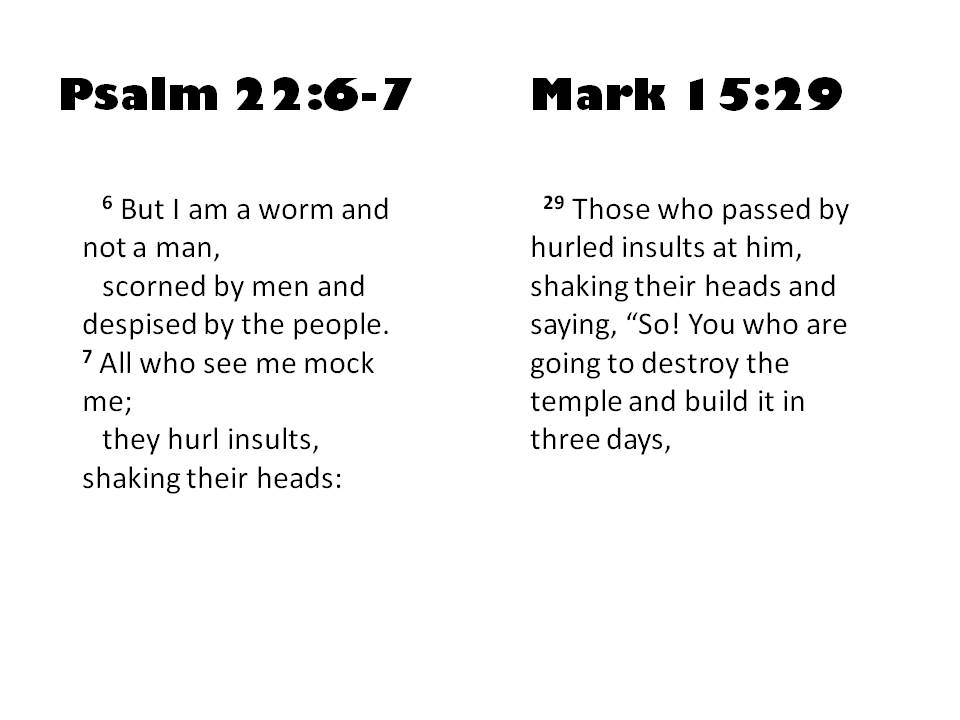
Psalm 22's Connection with Good Friday


The four Gospels have some differences, but there is one strong (and maybe strange) similarity: the climax of their story is the cross.  Jesus had clearly told his disciples what is going to happen to him, and yet they are still surprised.

Holy week commemorates the last week of Jesus' earthly life stretching from Palm Sunday through Easter Sunday.  Thursday is often called Holy Thursday or Maundy Thursday.  The word "Maundy" is connected to the  word 'mandate' which was a significant event in the upper room when the disciples ate the last supper with Jesus.  In the Gospel of John, Jesus gives them a new commandment/rule/mandate that they should live by: love.

Good Friday was good for us, but hard for Jesus.  The church services on Good Friday often revolve around the last words of Jesus which he spoke while he was on the cross.  There are seven, but all four Gospels are needed to get the full set of seven.  His phrases were monumental: Father, forgive them... In to your hands I commit my spirit... Today you will be with me in paradise... It is finished.

Yet one phrase is rather disconcerting.  It doesn't completely match what we think about God.  God would never really forsake Jesus, would He?  Since Jesus is God, God never really did forsake Jesus, right?  Why did he say that?  Why would anyone want to write it down?

I believe that the pain Jesus was going through was greater than we can imagine.  It is true that it was physically excruciating, but the sins of all people were placed on him in fulfillment of the atonement for sin done in the Old Testament.  With God being holy, the Father could not embrace the Son whom he loved because of the sin heaped upon him.  Jesus must have felt lonely.

And yet I think there is another significant reason that Jesus spoke these words.  If I said the words, "Mary had a little lamb," you would probably have several ideas in your head.  One idea is Mary having a lamb, but it would probably also be joined with the ideas that this lamb has really white wool and would follow Mary all over the place.  "Mary had a little lamb," is not so much a sentence as much as the first line to a familiar song.  Since it is so common, I can equate that one line with the entire song.

Psalm 22:1
My God, my God, why have you forsaken me? 
   Why are you so far from saving me, 
   so far from the words of my groaning?

The entire psalm is being recalled by only saying the first line.  When Jesus said the first words, the rest of Psalm 22 starting flowing through the minds of those faithful Jews who knew this Psalm.  The words of this psalm were strangely similar to what they were witnessing.


I wonder what those people felt when they made the connection between Psalm 22 and what was happening. I imaging the gasp or chill you get from a great suspense or mystery where the clues and answers have been given throughout the entire story, but only at the end are they able to be assembled to make sense.  Can we stand there with the centurion and declare, "Surely, he was the Son of God."?  The story of Jesus is the greatest story every told.

This is how we can be like Jesus.  We are not able to be born of a virgin, walk on water, heal the sick, raise the dead, or endure the sufferings that Jesus went through.  We are able to die, though.  This is why Paul says that "If we have been united with him like this in his death, we will certainly also be united with him in his resurrection." We can be joined with him on Good Friday, so that we might also celebrate with him on Easter.  Easter is about our resurrection, too!

This is probably why the author of Revelation makes the point that to be connected to The Lamb, we should:

Revelation 2:10b
Be faithful, even to the point of death, and I will give you a victor's crown.