Friday, January 25, 2013
Listen Up
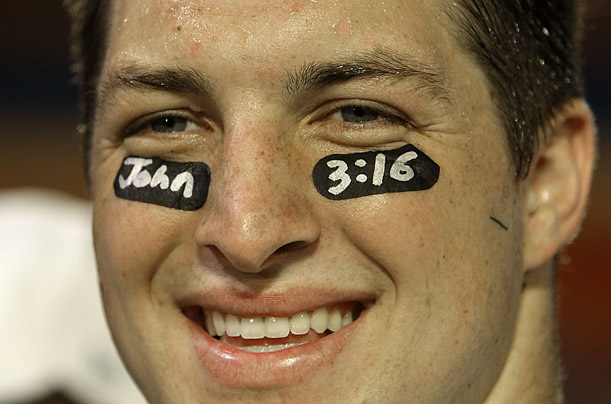
The most publicized Bible verse is probably John 3:16. It has been called the "Gospel in a Nutshell" because it has the overall message of the Gospel (good news about Jesus): God loves the world, he gave his Son for the world, and those who believe in the Son will have eternal life.
Tim Tebow was a football player for the New York Jets this past year and has been quite controversial lately. Throughout his college and professional career his has been a very outspoken Christian, known for "Tebowing" which is taking a knee and praying, which he will often do in the end-zone. While he has not been the 'best' quarterback according to form and statistics, he won many games last year.
Before John 3:16, there was Deuteronomy 6:4-9. The "John 3:16" of the Jewish Old Testament was the rally cry of the Israelites: There is One God - the Lord, so love the Lord with everything you have, and always talk about this Word of God that He has given to us.
Deuteronomy 6:4-9
4 Hear, O Israel: The LORD our God, the LORD is one. 5 Love the LORD your God with all your heart and with all your soul and with all your strength. 6 These commandments that I give you today are to be on your hearts. 7 Impress them on your children. Talk about them when you sit at home and when you walk along the road, when you lie down and when you get up. 8 Tie them as symbols on your hands and bind them on your foreheads. 9 Write them on the door frames of your houses and on your gates.
This section was not referred to as the "Law in a Nutshell" (though maybe it could be), but rather the "Great Shema." Shema is the Hebrew word that commands people to 'listen' or 'pay attention' or 'hear' what is being said.
So many other cultures had a collection of gods - the Greeks, Romans, Egyptians, Hindu's, and every other culture. Jews were 'odd' because of their claim that there is only one God in charge of everything. Understanding John 3:16 can give others a better idea of what is important to Christians. Understanding Deuteronomy 6:4-9 can give us a better idea of what has been important to the Jewish culture throughout time, including the Jewish culture of which Jesus was a part.
Friday, January 18, 2013
With Faith
There are a few chapters in the Bible that have such a strong theme that they are known by one word.
1 Corinthians 13 is known as the Love chapter. "Love is patient, love is kind... and the greatest of these is love."
Hebrews 11 is known as the Faith chapter, containing the word more than two dozen times.
Luke 15 is sometimes called the lost chapter, containing the stories about the lost sheep, the lost coins, and the lost (prodigal) son.
Faith is important. It is by grace we have been saved, through faith - Ephesians 2:8. During the reformation a strong emphasis was put on three 'sola' phrases: Sola Fide, Sola Gratia, and Sola Scriptura meaning Faith Alone, Grace Alone, and Scripture Alone.
This side of heaven, faith and hope will support us through difficult times, but a day will come when God's Kingdom is realized and there will be need for neither, for God will be with his people.
Hebrews 11:1
Now faith is confidence in what we hope for and assurance about what we do not see.
Hebrews 11 not only defines faith, but it continues on with the powerful examples of faith that we see in the Old Testament from the likes of Abraham, Noah, Jacob, Moses, and many others. Those people, as well as those we have known personally such as grandparents who lived a life of faith, have given us examples to emulate. The author of Hebrews builds on the momentum of this great faith chapter to lead into chapter 12:
Hebrews 12:1-2
1 Therefore, since we are surrounded by such a great cloud of witnesses, let us throw off everything that hinders and the sin that so easily entangles. And let us run with perseverance the race marked out for us, 2 fixing our eyes on Jesus, the pioneer and perfecter of faith. For the joy set before him he endured the cross, scorning its shame, and sat down at the right hand of the throne of God.
Friday, January 11, 2013
The Unexpected
One of my favorite stories of surprises is the first time Susan Boyle auditioned on the Britain's Got Talent television show. When she entered, the judges and audience saw a goofy lady, but when she began to sing they were filled with awe. The smiles and cheering are contagious.
One of my classmates in kindergarten would often be caught eating glue during our art and crafts time. We may have laughed at the time, but now he is known as the guy who controls a multi-million dollar company, not the guy who eats glue.
The truth of finding the unexpected is connected to the principle Jesus taught about judging.
Matthew 7:1-2
Do not judge, or you too will be judged. 2 For in the same way you judge others, you will be judged, and with the measure you use, it will be measured to you.
You are a wonderful person. Sometimes people are able to see that, and sometimes that gets hidden in the messy reality of the world that we live it. That messiness does not define you, so don't let it. Don't judge others. Don't let the judgments of others control you.
Unfortunately, we live in a world that will remain messy this side of heaven. God is with you through that messiness, and wants to develop a deeper relationship with you. He wants to talk to you, and he wants to listen, as well.
Matthew 7:7-8
Ask and it will be given to you; seek and you will find; knock and the door will be opened to you. 8 For everyone who asks receives; the one who seeks finds; and to the one who knocks, the door will be opened.
He will answer the door, so don't hesitate to knock!
Friday, January 4, 2013
What we Need
What do you really need? There are probably more things that we think we need than we actually need. According to our science class, we need food, air, water, and shelter. Society would say you need a job, community, and transportation. The stores before Christmas tell me that I need the latest gadgets and electronics, and I am often tempted to think they are right.
Some theorists would say that we need safety, a purpose, and our highest need is love. That may true since God is love. 1 John 4:8.
Six out of the seven petitions in the Lord's prayer deal with concerns that might be considered more spiritual: holiness, God's will, God's kingdom, forgiveness, temptation, evil. One of the encapsulates all the physical concerns we have.
Matthew 6:9-13
9 “This, then, is how you should pray:
“‘Our Father in heaven,
hallowed be your name,
10 your kingdom come,
your will be done,
on earth as it is in heaven.
11 Give us today our daily bread.
12 And forgive us our debts,
as we also have forgiven our debtors.
13 And lead us not into temptation,
but deliver us from the evil one.’
hallowed be your name,
10 your kingdom come,
your will be done,
on earth as it is in heaven.
11 Give us today our daily bread.
12 And forgive us our debts,
as we also have forgiven our debtors.
13 And lead us not into temptation,
but deliver us from the evil one.’
This is a little different than the version we usually say in church or chapel. One of the more significant differences is the request to keep us away from "the evil one" and not just "evil" in general. That makes me curious why it would be rendered differently. That middle verse, 11, is about physical things and it calls those things 'daily bread.' It would have reminded people during Jesus' day about the Israelites who were only supposed to collect enough food for one day and depend on God. It would also have reminded them of a Proverb.
Proverbs 30:8-9
8 Keep falsehood and lies far from me;
give me neither poverty nor riches,
but give me only my daily bread.
9 Otherwise, I may have too much and disown you
and say, ‘Who is the LORD?’
Or I may become poor and steal,
and so dishonor the name of my God.
It also might remind us that in John 6, Jesus referred to himself as the Bread of Life, the food that people really need.
As far as 'things': not too much, not too little. As far as 'God': the more the better.
"God, help us want You!"
Monday, December 24, 2012
Immanuel
My home congregation, growing up, was called Immanuel. Sort of.
The original leaders thought 'Shiloh' would be a good name for the church, the place where God's people gathered (Joshua 18). The German pronunciation was more like 'Silo' than 'Shiloh,' and this named seemed appropriate for a small church in a farming community. But the official name is Immanuel.
Matthew said that the baby Savior should be called Immanuel (God with us) as well as Jesus (The Lord Saves). Since no one in the Gospels ever called Jesus by the name 'Immanuel,' it seems that name holds more purpose in meaning than identification. The miracle of the incarnation is that God came to us - the God of the universe became a helpless baby; the Word became flesh.
The "im" is the preposition "with." "manu," the substance of the word, is an elongated pronoun meaning "us." "El" is short of Elohiem or the Hebrew word for 'god,' here specifically referring the one and only God. With-us-God = Immanuel.
This Christmas season the word struck me differently than before since I noticed the lack of a verb. God-with-us is not really a complete thought, but it implies the verb "is" making the sentence "God is with us." Implied words happen often, such as in nearly every imperative sentence, every command that is given. "Pick up your room." is a complete sentence and implies the subject 'You' at the beginning - "You, pick up your room." The one word sentence "Listen." does the same - "You, listen." Since there is no verb, we can imply the verb 'is.'
But since there is no explicit verb written, you might find that this Christmas you are better served by implying the past tense of the verb - was. God was with us, this year. There were some interesting times, some difficult challenges, some hard decisions, but God was indeed with us through them. Maybe the same could be said about your future as you look ahead at the unknown. Our country is in a war with the threat of other wars, on a 'fiscal cliff,' and falling behind as a world power, but God will be with us. Families and jobs may look different in the coming year, but God will be with us.
However, at any given moment you must live in the present. You can learn from the past and prepare for the future, but you must live in the present. Therefore, maybe the most appropriate implied verb is the present form - God is with us. God came down from heaven on Christmas and was with people here on earth for a time, and he will return to judge the world and take us to heaven in the future, but right now you need to know that God is with you. Immanuel.
Merry Christmas.
The original leaders thought 'Shiloh' would be a good name for the church, the place where God's people gathered (Joshua 18). The German pronunciation was more like 'Silo' than 'Shiloh,' and this named seemed appropriate for a small church in a farming community. But the official name is Immanuel.
Matthew said that the baby Savior should be called Immanuel (God with us) as well as Jesus (The Lord Saves). Since no one in the Gospels ever called Jesus by the name 'Immanuel,' it seems that name holds more purpose in meaning than identification. The miracle of the incarnation is that God came to us - the God of the universe became a helpless baby; the Word became flesh.
The "im" is the preposition "with." "manu," the substance of the word, is an elongated pronoun meaning "us." "El" is short of Elohiem or the Hebrew word for 'god,' here specifically referring the one and only God. With-us-God = Immanuel.
This Christmas season the word struck me differently than before since I noticed the lack of a verb. God-with-us is not really a complete thought, but it implies the verb "is" making the sentence "God is with us." Implied words happen often, such as in nearly every imperative sentence, every command that is given. "Pick up your room." is a complete sentence and implies the subject 'You' at the beginning - "You, pick up your room." The one word sentence "Listen." does the same - "You, listen." Since there is no verb, we can imply the verb 'is.'
But since there is no explicit verb written, you might find that this Christmas you are better served by implying the past tense of the verb - was. God was with us, this year. There were some interesting times, some difficult challenges, some hard decisions, but God was indeed with us through them. Maybe the same could be said about your future as you look ahead at the unknown. Our country is in a war with the threat of other wars, on a 'fiscal cliff,' and falling behind as a world power, but God will be with us. Families and jobs may look different in the coming year, but God will be with us.
However, at any given moment you must live in the present. You can learn from the past and prepare for the future, but you must live in the present. Therefore, maybe the most appropriate implied verb is the present form - God is with us. God came down from heaven on Christmas and was with people here on earth for a time, and he will return to judge the world and take us to heaven in the future, but right now you need to know that God is with you. Immanuel.
Merry Christmas.
Monday, December 17, 2012
Deliver Us From Evil
We pray this line, often, as we say the Lord's Prayer. We ask that God would deliver us from evil, from the Evil One, from the one who would incite such awful acts as witnessed in Connecticut last week. The pain and heartbreak this continues to cause is overwhelming from so many different aspects.
And the tragedy hits close to home. The pain of this event is so hard because it happened to children, because it happened to children who were supposed to be in a 'safe place.'
One of the lines that stood out to me this past weekend was a quote from Mr. (Fred) Rogers. It seems applicable to any crisis, but maybe more appropriate since this crisis involved children. He said,
"When I was a boy and I would see scary things in the news, my mother would say to me, "Look for the helpers. You will always find people who are helping.”"
I cannot imagine the pain of losing a child, and yet it seems like too many parents, do. It is not natural to bury a child. Many children die every day from many different causes: cancer, malnutrition, other diseases, car accidents, violence... We pray for deliverance from evil whether it applies to a whole country in mourning, or rather just one family or individual who is in pain. I cannot imagine the pain of losing a child, but God can. Jesus was his only son, and yet each of those twenty children where God's children, as well. Every child.
The same prayer that contains "deliver us from evil" also contains "Thy will be done." God did not want this event to happen, and He grieves the loss of every child. Martin Luther wrote explanations to each part of the Lord's Prayer, and he says that praying the phrase "Thy will be done" is not a magic formula for causing God's will to be done - it's going to happen whether we pray or not. Instead, when we pray, we are asking that we can be part of God's will being done here on Earth.
May God's will be done - through each one of us.
And the tragedy hits close to home. The pain of this event is so hard because it happened to children, because it happened to children who were supposed to be in a 'safe place.'
One of the lines that stood out to me this past weekend was a quote from Mr. (Fred) Rogers. It seems applicable to any crisis, but maybe more appropriate since this crisis involved children. He said,
"When I was a boy and I would see scary things in the news, my mother would say to me, "Look for the helpers. You will always find people who are helping.”"
There were helpers in Sandy Hook. There are helpers for us, as well.
I cannot imagine the pain of losing a child, and yet it seems like too many parents, do. It is not natural to bury a child. Many children die every day from many different causes: cancer, malnutrition, other diseases, car accidents, violence... We pray for deliverance from evil whether it applies to a whole country in mourning, or rather just one family or individual who is in pain. I cannot imagine the pain of losing a child, but God can. Jesus was his only son, and yet each of those twenty children where God's children, as well. Every child.
The same prayer that contains "deliver us from evil" also contains "Thy will be done." God did not want this event to happen, and He grieves the loss of every child. Martin Luther wrote explanations to each part of the Lord's Prayer, and he says that praying the phrase "Thy will be done" is not a magic formula for causing God's will to be done - it's going to happen whether we pray or not. Instead, when we pray, we are asking that we can be part of God's will being done here on Earth.
May God's will be done - through each one of us.
Concordia Publishing House
Friday, December 7, 2012
Light and Numbers
Light is a pretty cool thing. From a science perspective, it is without rival. Light and dark are not opposites, rather darkness is simply the absence of light. If light and dark were to have a fight, light would win. Every time. Imagine an entire Edward Jones Dome full of darkness. Light one candle in that dome and you could see it from anywhere in that enormous place. Light makes itself present. It takes effort to hide light.
Light is pretty is a pretty important part of the Christmas season. Candle-light services are popular. Advent wreaths progress with light until Christmas. Christmas lights decorate many houses and businesses. It's Biblical. John wrote that about Jesus coming into the world at Christmas time and said, "The true light that gives light to everyone was coming into the world." Isaiah said "The people walking in darkness have seen a great light." A little while later in Isaiah chapter 9 we have the Christmas verses, "For unto us a child is born."
Jesus is the light. By him being present in our lives, we shine forth, as well. This is why Jesus says,
Matthew 5:16
In the same way, let your light shine before others, that they may see your good deeds and glorify your Father in heaven.
Jesus did not say that you might have the opportunity to be the light if you work really hard at it. You are the light of the world, so let those lights shine for the right reasons. Love shines bright. Let it shine.
How do you shine? By living differently than our dark world. By looking to follow the heart of God and not just the letter of the law. Jesus went on to say,
Matthew 5:43-44
43 “You Matthew 5:43-44have heard that it was said, ‘Love your neighbor and hate your enemy.’ 44 But I tell you, love your enemies and pray for those who persecute you
In addition, I want to share a little about numbers that have significance in the Bible.
There are some significant numbers in the Bible, so it might be a good idea to list a few of them. They tend to appear from time to time, like the number 14 for David. Most of them are more common than that one, though, so we'll run through a quick list of important numbers.
Three is a number that is usually associated with God or heaven or spiritual things. Some important three's would include the 3 person of God in the Trinity and Jesus being in the tomb for three days.
Four, on the other had, is a very earthly number. There are four directions (north, east, south, west), four seasons (spring, summer, fall, winter), four hemispheres, and four ancient elements (earth, wind, fire, water). This brings significance to Jesus' heavenly resurrection (three days in the tomb) compared to Lazarus' earthly resurrection (four days in the tomb).
When you add three and four, you get the complete number 7. Seven shows up a lot in the book of Revelation symbolizing completeness. A week is complete with seven days, like the seven days of creation. When Revelation was sent to the seven churches, it could be argued that it was sent to all the churches, the 'complete' number of churches.
One less than complete would be the devil's number of 6. The devil tries to imitate God's completeness, but comes up short.
10 is a number that represents power. Numbers are often multiplied by powers of ten. The beast in Revelation having 10 horns is a symbol of power.
The church is represented by the number 12. The people of God in the Old Testament were the twelve tribes of Israel. The people of God in the New Testament followed the teachings of the twelve disciples. All the people of God surround God's throne, represented by the twenty-four elders (12 + 12).
And 40 is a number for change. The earth was changed in the forty days it rained during Noah's time. The Israelites were changed during forty years of wandering in the desert. Moses was changed after spending forty days on the mountain with God. Jesus was changed during his temptations in the desert, being prepared for ministry.
Subscribe to:
Posts (Atom)